
It's 5:58 p.m. Your class with Laura starts in two minutes and you can't remember where you left off last week. Did you assign homework? Did you finish the conditional or leave it half done? Didn't she mention a trip to London that you wanted to circle back to for some real-life practice?
You open WhatsApp to dig up the voice note where she told you about it. Then the spreadsheet where you jot down, more or less, each student's progress. Then a notebook. By the time you finally find the note it's 6:01 p.m., Laura has been waiting in the video call for a minute, and you start the class winging it.
I know exactly how that feels, because I've lived it thousands of times. That sense that a whole week has flown by and you're not sure how. That flash of feeling "unprofessional." Nobody actually copes by juggling five different apps and running on memory. The full context of each student grows week after week, month after month. With twenty or forty classes a week, that math gets away from you. You're a language teacher, not an admin machine.
You love the time you spend in class, with people, watching them progress, but everything around it drags you down. You're missing a system that works, and you're carrying too much mental load. In this article we'll look at how to stop running on memory and build a tracking system that holds up between one class and the next. You don't need to be a systematic person or have a rigid, boxed-in mind. Your goal is simple: walk into every class knowing exactly where you are.
Your problem as a language teacher: the information is scattered
When you're starting out, your head is more than enough. Three, four, five students, and you remember everything: who hates grammar, who needs you to speak slowly, who's always late on Tuesdays. Then the business grows. Before you know it you're up to twenty-five people with twenty-five stories, and the information is still there, growing exponentially and spread across places that don't talk to each other.
A bit in WhatsApp. A bit in the spreadsheet. A bit on sticky notes on your screen. A bit in your head. And a bit nowhere at all, because that comment your student made about their official exam, you heard it, you nodded, and it vanished into the inscrutable labyrinth of your memory.
Good tracking is what separates someone who simply "teaches classes" from someone who "guides a process," and your students notice even if they can't name it. When that tracking is missing, you repeat content you'd already covered (or worse, you assume it's known when it was actually left half done), and you lose the personal threads that make a person feel heard. Every class costs you a little more. Partly because you have to recall an ever-growing context. Partly because your motivation dips, along with your students', when it isn't clear whether you've made progress or not.
Good tracking is what turns a string of loose classes into a set of actions that add up to a process. The good news is that it can be systematized, in 2026 more than ever before. Read on to find out how.
Step 1: keep everything in one place
This is the foundation. Without it, the steps that follow won't hold. As long as each student's information lives in five different places, no habit or system will stick.
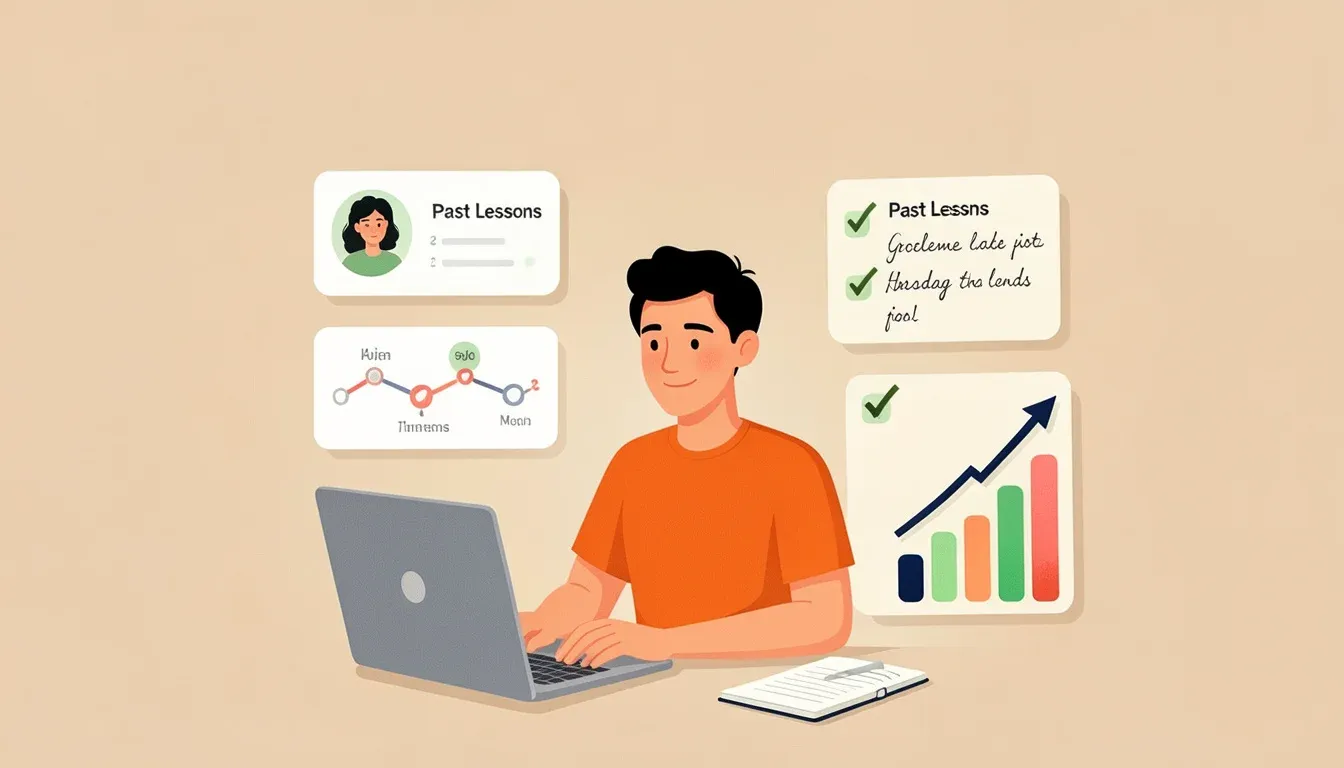
Keep a single record per student. Their class history, your notes from each session, homework, payments, contact details. One place you go to before every class and write in afterward. That's it.
You have three routes, and each one has a price. First: the spreadsheet. It's free and flexible, but it turns into a monster the moment you pass ten students. Endless tabs, formulas that break, a sheet you're half too lazy and half too scared to open. It's good for numbers, not for the nuance of "her dog is sick, ask about the surgery in two weeks." By the way, if the spreadsheet has already outgrown you, I explain why it's worth saying goodbye to Excel in another article.
Second: the notebook. It's pleasant and quick to write in, but you can't search it. When you want to remember what you did three months ago, you'll be flipping pages like someone rummaging through a drawer. You scribble everything down any old way and later you can't remember what that word even meant. Was it their favorite song? Was it their aunt's name?
The third option is an app built specifically for teachers. Each student has a record, the notes stay attached to the exact class where you wrote them, and you can search all of it in seconds. At SmartCookie we built exactly that, an app for language teachers, because I was sick of jumping between the calendar, my notes, and WhatsApp. In SmartCookie everything lives in the same place: your calendar, your notes, and your students.
Payments live in that same student record too, by the way. If collecting them is your other weak spot, here's a guide to getting paid on time without feeling guilty.
Step 2: write notes your future self will understand
Centralizing does nothing if what you write down is indecipherable. "Review past tense" is not a useful note. The simple past? The continuous? Was she struggling with it, or was it just next in the syllabus? Your two-weeks-from-now self has no idea. Or maybe it does, but your two-months-from-now self definitely won't. Or maybe that one does too, if you only have two students. And when you have twenty? And when you have groups?
A good tracking note answers three questions: what we did, how it went, and what comes next. This bare-bones template will do the job:
- Today: what you worked on, specific content and activity. "Past simple vs. present perfect with examples from her real life."
- How it went: the nuance you'd otherwise forget. "Mixes up 'for' and 'since.' Vocab OK."
- Next: the starting point for the following class. "Job-interview role-play. She's got one on Sept 5."
That last point is essential, which is why it gets its own step below. Notice the personal detail too. The fact that Laura has an interview next week, and that you remember it, is what will make the next class feel tailor-made.
A foolproof trick: write the note the moment class ends, without exception, or, if you can, in the last two minutes while your student is still in front of you. "I'll write it later" doesn't exist. Later, another student shows up who also needs your attention and needs you to remember what matters in their life and their learning. If your notes live attached to each session (like when you write them right on top of the class) closing that loop is a single click. Don't trust that you'll remember, because you won't, and that's fine. That's what notes are for!
Step 3: set the next steps before you close the class
If you take away one idea from this whole article, let it be this one.
Tracking between classes isn't won at the start of the next class. It's won at the end of the previous one. The best moment to know where you'll pick up is while the context is still warm. A week later, you have to start cold, and that's exactly when you lean on the notes you took well the class before. Before you say goodbye, thirty seconds: write down the starting point for next time. It matters to be clear about what you did in class, but it's absolutely essential to be clear about what you're going to do in the next one. That gives your students a sense of direction and security. And you get to feel like the true professional you actually are.
Think of it as a note you leave for your future self right before you head out, while you still remember everything. That future self, the one at 5:58 p.m. with class about to start, is going to thank you for it. Really, never forget your future self.
Step 4: turn tracking into a two-minute ritual
This is where almost every system falls apart. If they depend on willpower, they fall apart. Willpower, with twenty-five students and your mind in a thousand places, is an unreliable resource. You can't ask that much of yourself. Or rather: you can, but you shouldn't. It isn't efficient and you suffer more than you need to.
Being more consistent won't help you nearly as much as having a tracking system so small and so automatic that it requires no decision at all. Split it into two micro-moments and attach them to something you already do like clockwork.
The wrap-up is the last two minutes of each class: before you say goodbye you write the "today, how it went, next" and attach it to the session. Because it's glued to the end of class (something that always happens, since every class ends) you don't have to remember to do it separately. The warm-up is the first two minutes before each class: you open the record, read the last note and the next step, and you already know where to begin.
Do the math. Four minutes per student (two at the start, two at the end of class) save you the improvising and that constant feeling of playing catch-up. If this topic is useful to you, you can read this article on how to save hours every week with better time management. When you have a tool that shows you the record right next to the class on your calendar, those four minutes shrink even further, because the information is already in front of you without any searching. In SmartCookie, when you open a class you see that student's history and notes without moving an inch, and the warm-up becomes almost automatic.
Like any habit, at first you'll remember by force, and in two weeks (or three, or four, but at some point) you'll do it without thinking. Just like the gym: the first days are hard, then your body asks for it. And if, beyond time management, you'd like to read more about organization in general, take a look at the 5 steps to organize yourself as a freelance teacher that I wrote based on my own (chaotic) experience as a teacher since 2016. Easier said than done, but you have to start somewhere.
Step 5: make your student part of the tracking
Tracking doesn't have to be something you do in secret, alone with your notes. The most effective teaching and learning processes are shared, and bringing your student into the process multiplies their motivation and their sense of achievement.
All you have to do is give them visibility into their own progress. When a student can see where they're going, they get more involved, they do their homework more often, and, this one matters for your business, they take far longer to think about quitting. It costs you no extra work, because it comes straight out of what you're already writing down. Close each class by naming the next step ("next time we pick up the interview"), which is the spoken version of your written note. Start the next class by mentioning some detail (one that came from your record, not your memory): for your student, that's the difference between just any teacher and their teacher.
Every so often, especially when a student's motivation is flagging, take a breather and stop for a moment to look at where they came from and where they are now. There is always, always progress, however small. Simply staying in class and continuing to put in the effort is already a big achievement, even when the results don't look miraculous. Remember: there are no shortcuts to learning a language. One new word or structure a day adds up to a lot by the end of the year.
That warm, empathetic connection, remembering details from your students' lives, being able to adapt the class to the person in front of you, is something a machine will never (never, ever) be able to replicate. As all-powerful as artificial intelligence may seem, it turns out it isn't. There are certain things AI simply doesn't understand. Keeping good track of what happens in class with your students will help you be more present and give them the (human) attention that AI will never be able to offer.
In short
Five steps for good tracking between classes: keep everything in one place, write notes your future self will understand, set the next step before you close the class, turn it into a two-minute ritual, and bring your student into the process. None of these steps is very complex on its own. The hard part, as always, is consistency. Keeping those five steps going over time and not sliding back into "running on memory" and having everything scattered across open tabs. Whatever tool you use should carry the job of storing the information, so that you can shed that mental load and devote yourself to what you're genuinely good at (and where you're irreplaceable).
If you want to stop fighting with spreadsheets and WhatsApp, try SmartCookie for free or book a demo and see how it fits the way you teach.
Frequently asked questions

The bad news is that time flies.The good news is that you can learn how to manage it. If you want to simplify your schedules, lesson planning, student tracking, notes, corrections, and student management, you do not need to juggle ten different apps.SmartCookie is the software for language teachers that handles the administrative tasks for you, so you can focus on what you love most: teaching.