
You already know AI can help you with almost everything, but inside that "almost" there's exactly the magic you need in order to teach languages. Among other things, AI doesn't understand metaphors. That's why, in this article, I'm going to compare lesson planning to the process of getting a tattoo.
When you get a tattoo, before the needle ever touches your skin, the artist presses a sheet of paper against you that leaves a purple outline behind (the paper is called transfer paper and the outline it leaves is the stencil). My thesis in this article is that preparing the tattoo properly matters just as much as the tattooing itself. Without good preparation, creating something good is far harder, close to impossible. And that something can be a language lesson or a tattoo… Either way, the marks can last forever!
The moment the session starts, the ink covers the stencil and everything just "flows." It flows so well that the whole business of preparing and positioning that little sheet of paper looks like something you could skip. Even so, there are no tattoo artists who work without preparation. And there are no language teachers who walk into a lesson having prepared nothing, no matter how much experience they have.
It is true that, once you gain experience (in any field), it looks like no preparation is needed at all. It's a trick of the eye: you prepare faster and faster precisely because of all that accumulated experience.
Planning a lesson is not designing nice materials (with or without AI)
Dozens of the language teachers I've had the pleasure of talking to over the past ten years plan their lessons as if the planning were the final product. They forget that planning has one job and one job only: to make the lesson easier. In other words, to promote and optimize the learning of every student who is going to be in that lesson.
When "the stencil becomes the tattoo," teachers pour hours and hours into how the materials look, for example. You might think that with AI those hours drop to zero, but remember that AI speeds up everything, inefficient processes included. You have to keep a close eye on the balance between the goals of the lesson and the (current) reality of your students.
"There is nothing so useless as doing with great efficiency what should not be done at all." Peter Drucker, 1963.
If your student turns up with a question left over from last week, with a meeting at work that went sideways, or with something they overheard on the street that they're curious about… In my opinion, those things come first. So where does that leave your 37 example sentences of the compound conditional, complete with images, on a Padlet?
In a tattoo studio, the stencil goes on in minutes (even when it drags a little) and the session lasts hours. The preparation is never longer than the piece itself. Your lessons should work the same way: you should never spend more time planning a lesson than teaching it.
What's more, a good stencil doesn't dictate where every drop of ink goes. It just marks the outline and warns you where not to stray. Everything else happens live, with the person right there in front of you. Do you see how much this looks like a language lesson?
The 5 steps to plan a language lesson in 10 minutes
This is what works for me when I need the stencil ready for a one-hour lesson. Ten minutes (maximum) with a fixed framework that repeats itself every single time. The advantage of always using the same framework is that you stop deciding how to plan and simply plan.
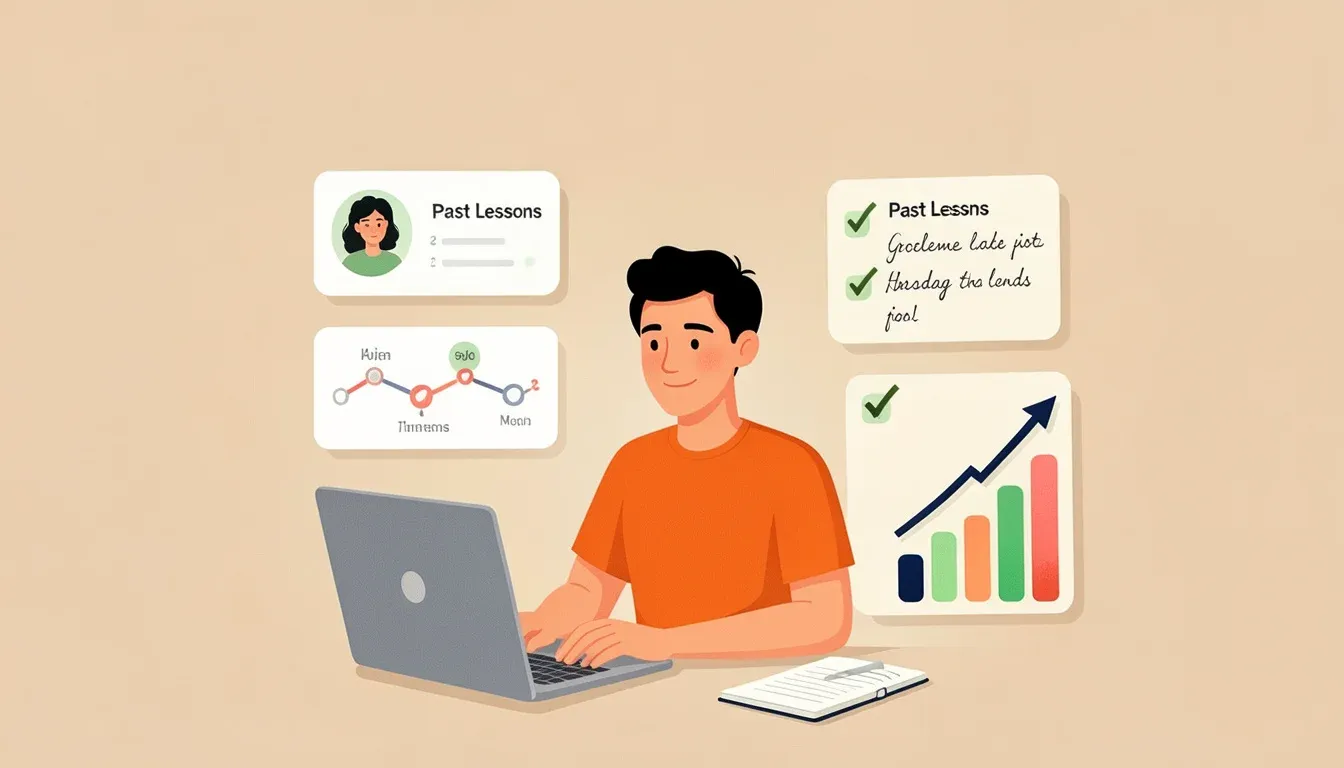
- Where did we leave off? Read the note from the previous lesson. What tripped them up, what you promised to bring to class (or what your student promised you), which expression they got wrong twice, what was set for homework. If you don't have that note, this is the first habit to build (and no, whatever Excel tab you're using doesn't count). It takes seconds if you do it at the end of every lesson and, once you really start applying it, it saves you hours. Truly.
- Goal. One single goal. One sentence, starting with a verb, no technical jargon: "she'll be able to tell the story of an argument in her apartment building."
- Anchor. The material the lesson revolves around: a two-minute audio clip, a photo, an email, a headline, a scene. Just one, and taken from real life. If it takes you more than two minutes to find it, that's a bad sign: it means you're creating it (instead of simply choosing it) or that things are chaotic and you need more order.
- Defined stages. Lead-in, controlled practice, free production, wrap-up. Those are mine, but of course you can use whatever stages suit you. Write one line for each. You don't need any further explanation.
- Plan B. A backup activity in case the lesson speeds up or gets stuck. An open question, a vocabulary game, a roleplay you already know by heart… Your call!

Tell us where to send it.
How to adapt the lesson when your student shows up with other plans
A tattoo artist can have the perfect stencil and then find that the skin in that spot takes the ink differently, or that the person can't sit through the whole session. When the plan falls apart, a genuinely good artist knows how to adapt. Pushing on as if nothing were happening is certainly not a good option. The skin is in charge!
A lesson is no different. Your student arrives with no energy, or with far too much of it, or with big news. They bring you a beautiful mistake you hadn't anticipated, one that's good for twenty minutes of class. That's the lesson you need to teach, not the one you had lined up.
The stencil exists for exactly this reason: so you can stray and still find your way back. When we underprepare, there's no clear direction, and that can stress us out. When we overprepare, we grow too fond of our plan, and moving away from it can stress us out too.
Planning efficiently means having enough structure to improvise without getting lost.
What to write down when the lesson ends (this is planning too)
A tattoo finishes long after the artist switches off the machine. There's the healing, and a few weeks later, more often than not, the touch-up: going over the line that didn't take, adding color where it came out weak...
The same thing happens with lessons and we almost never talk about it. What your student does between one lesson and the next is the healing. And the next lesson is the touch-up: you go back over what didn't hold, you strengthen what came out pale, you leave alone what has already settled.
That touch-up only works if you wrote something down when the lesson ended. Two lines are enough: what worked, what didn't, what's next. Thirty seconds at the end of the lesson. The key is that it happens RIGHT when the lesson ends, truly, not on Sunday afternoon while you try to remember what happened on Tuesday with Laura.
And that closes the circle, because those two lines are minute 1 of the next stencil for your next masterpiece, namely: your next lesson.
What planning a lesson well is really for
Millimeter-perfect planning with 5 shades of green for each column of the table can help your students, but that's not where the magic lives. What really has magical effects shows up later, maybe months later, when Laura writes to tell you she's just filled her coworker in on last week's gossip that she missed while she was on vacation.
Remember, planning a lesson well matters as much as the stencil does before a tattoo. And both the lesson and the tattoo can last forever.
By the way, with SmartCookie, step 1 of your planning is already done before you even sit down to plan: each student's notes are waiting right next to their next lesson, nothing to hunt for, always in order, no copying and pasting. Start free today.

The bad news is that time flies.The good news is that you can learn how to manage it. If you want to simplify your schedules, lesson planning, student tracking, notes, corrections, and student management, you do not need to juggle ten different apps.SmartCookie is the software for language teachers that handles the administrative tasks for you, so you can focus on what you love most: teaching.